
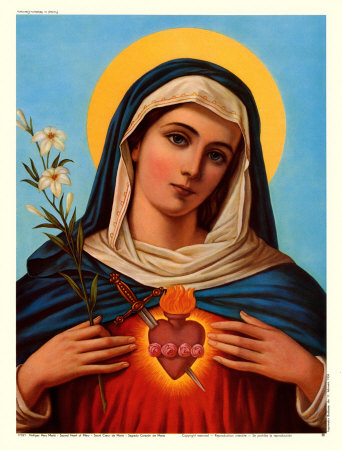
The title of the song itself already refers to the famed apostle of Jesus, Judas, knows for betraying Jesus by kissing him and by kissing him sentencing him to his death, but also denying that he one of the apostles. The music video starts off by showing several bikers with leather jackers and Gaga sitting on the back of one, while the man she is clutching too is wearing a golden crown of thorn. The jackets read the names of the apostles and hereby is referring to the twelve apostles and Jesus, the king who had to wear a crown of thorns. Her, clothing consisting of something purple at this point changes through out the video, each of the outfits seemingly referring to the portrayal of Mary Magdalene, but while wearing her blue and red outfit with a sacred heart stitched on it is a clear reference to the portrayal of Mary, the mother of Jesus. Is Gaga intentionally placing herself in the roles of both women, both connected with Jesus by love and their believe in him. By layering this image she is bonding herself and connecting herself with a leaning towards the good, towards a way of enlightenment and light.

While Judas is the the main imagine in the song, the being drawn to that which has betrayed you, while on the music video we see the dark side of Judas, his abusing, his brawling, his calling eyes to Gaga. By calling out that she is still in love with Judas, she is not, as a Catholic group has suggested, saying that she in fact is in love with the betrayal of Jesus, but with the darkness that comes with all the bad things that we encounter in life. The moment she sings "Forgive him when he tongue lies through his brain, even after three times he betrays me" we see a shot of Judas. In the scriptures Judas betrays Jesus three times, even though he has said he wouldn't. This line cleverly writes upon the idea that, even though we fight so hard not to do things, we still do them before we can question it, we might even do it more than once without realising it. Yet, the Christian faith has forgiven Judas for his betrayal, so could we when we are drawn towards the darkness, we forgive this things we do, only later realising it was not all good, but if we do not forgive ourselves for our dark choices we did not consciously make we would not be able to return to the light.
In one of the next shot we hear Gaga sing how she is going to bring him down, while she is pushing Judas off the stairs, while holding on to Jesus. The pushing away from the betrayal, the darkness that we before might have embraced but are trying to draw out with the light. She continues to sing about how Judas is a king with no crown, Judas, however, has not been seen as a king, thus has never the need of a crown. But, since Jesus is wearing his crown of thorns through out the clip, the crownless is Judas. Still she wants to take Judas down, even in a literal sense by pointing a gun at him, yet when it comes to it, Gaga has not the heart to pull the trigger, the only thing she can do is kiss him with the lipstick that pushes out of the gun when she pulls the trigger. In a sense, she seems to give Judas his own kiss, she gives him a Death sentence, because she cannot kill Judas, she cannot kill the darkness, she can only repent it by falling to the knees of Jesus, who puts his hand of her head, as to forgive her for her sins.

Yet, the lyrics of this part I find very interesting:
In the most Biblical senseGaga seems to be pointing how she feels about herself, a girl beyond repentance according to her own faith, but also how other might see her, a fame hooker, a prostitute wench. A double focalisation that seems not to only point to Gaga as artist, but also addresses the stigmas around Mary Magdalene who was accused of prostitution by religious groups at several times in history. Not only her actions makes her being judged, but also whatever she has to say, whatever she sings about, she is looking to the future, fighting for the future by being an equal rights supporter, she dares whatever darkness will judge her and feel offended by her kiss her, in reference to the Judas kiss, but she rather prefers that instead of taking offence they would stop listening to her if they do not like what they hear, ear condom being a clever way to put it.
I am beyond repentance
Fame hooker
Prostitute wench
Vomits her mind
But in the cultural sense
I just speak in future tense
Judas kiss me if offenced
Or wear an ear condom next time
She continues washing the feet of both Judas and Jesus, while in biblical context only the feet of Jesus was mentioned to be washed, while in historical context all feet were washed. To put it in the context of the music video, the washing of both feet puts both men in the same position, instead of making Jesus or Judas to be the special one, by washing both feet, she puts them on equal heights, lightness and darkness are not to be taken over by one another but treated equally. This, again, is also referenced to in the text: "Jesus is my virtue, Judas is the demon I cling to." Juxtaposed between the images of Gaga washer their feet, there are images of Gaga standing on a rock being engulfed by water, by others often referred to as an reference to the Birth of Venus, in which Venus stands upon a shell before a beach, water behind her. Which in neoplatonism is about arousal of physical and intellectual love. Which makes both Judas and Jesus an object of love, both physical and intellectual, they are opposites but both offer something humans long for.


No comments:
Post a Comment